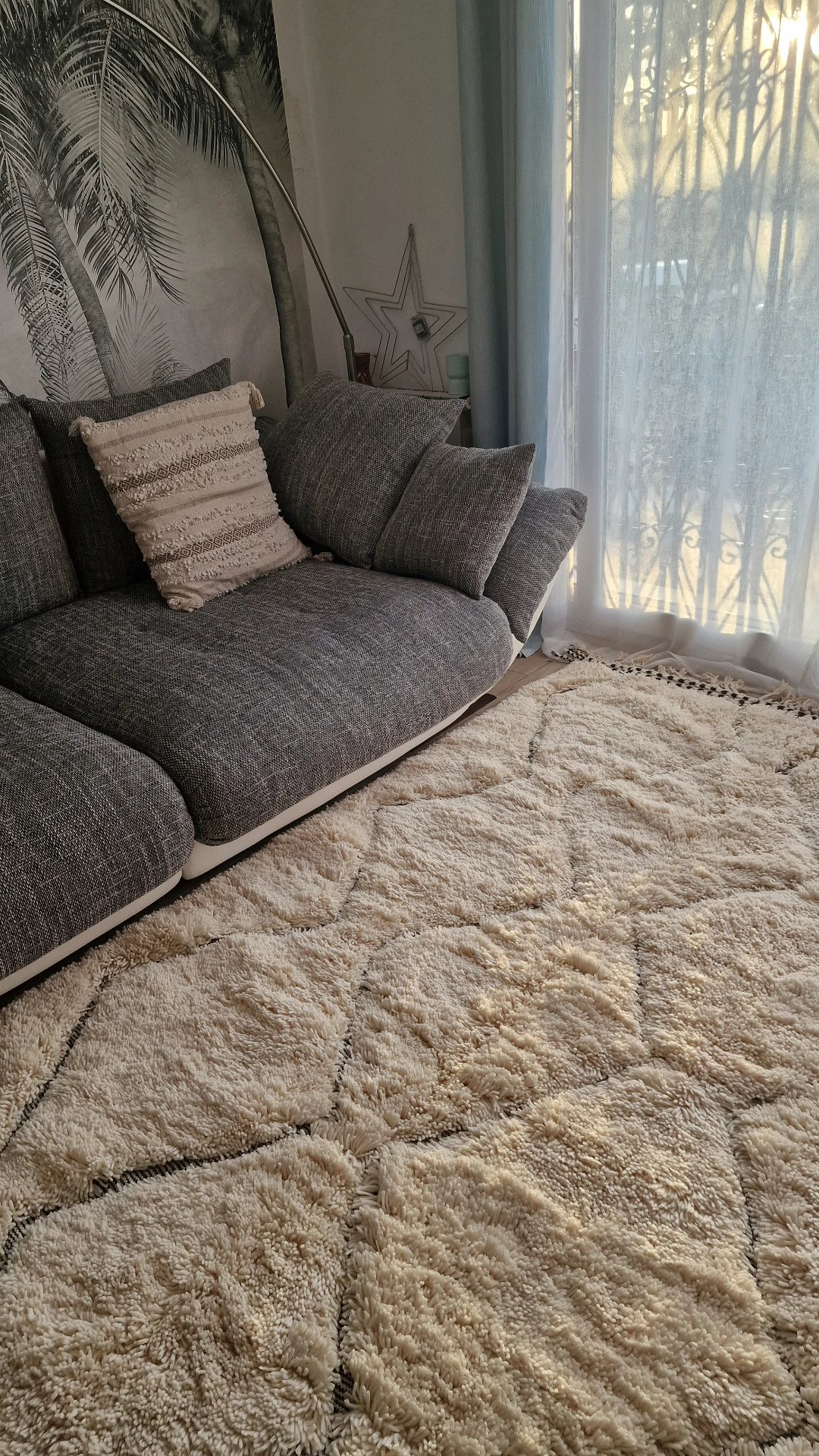
The Beni Ourain rug has become a decor icon: ivory background, bold black geometric patterns, thick and plush wool… You see it everywhere, from interior design magazines to big-box stores. As a result, imitations are multiplying, often made of synthetic fibers by machine. So how can you spot a real handmade Beni Ourain rug? Here are 7 simple clues to avoid being fooled.
What is a Beni Ourain rug?
The Beni Ourain takes its name from a group of Berber tribes in Morocco’s Middle Atlas. For centuries, the women of these tribes have hand-woven these long-pile rugs, originally to protect themselves from the mountain cold. They are recognizable by their natural off-white or ivory wool and their brown or black geometric patterns: diamonds, broken lines, zigzags. Each pattern is unique: it often tells the story, the region or the imagination of the weaver.
1. Look at the back of the rug
This is the most reliable test. Turn the rug over: on a genuine hand-knotted Berber rug, you can see each knot, slightly irregular, and the patterns also appear on the back, a little less sharply. A machine-made rug has a perfectly regular back, often covered with a backing fabric or a layer of glue.
2. Feel the wool
An authentic Beni Ourain is made of 100% sheep’s wool. It is dense, soft and slightly greasy to the touch thanks to natural lanolin, and it smells a little of wool for the first few days. Synthetics (polyester, acrylic) are shinier, more “slippery”, and can build up static electricity.
3. Look for imperfections
Paradoxically, small flaws are good news! Patterns that are not quite symmetrical, lines that wave, slightly uneven edges or a shade of white that varies: these are signs of a handmade rug. A pattern that is perfectly identical from end to end gives away a machine-made piece.
4. Check the fringes
On a hand-woven rug, the fringes are the continuation of the warp threads: they are part of its structure. On an imitation, they are often sewn or glued on afterwards.
5. Try the weight test
A real Beni Ourain is heavy: the wool is thick and the knots are tight. A 2 x 3 m rug can easily weigh over 10 kg. A rug that is very light for its size should raise a red flag.
6. Beware of prices that are too low
An authentic Berber rug takes a weaver several weeks, or even several months, of work. A large “Beni Ourain” sold for a few dozen euros is almost always a factory copy. A fair price also means fair pay for the women artisans.
7. Ask about its origin
Don’t hesitate to ask the seller questions: where does the rug come from? Who wove it? What is it made of? A passionate, transparent seller will be able to answer and send you detailed photos of the back or the finishing.
Beni Ourain, Azilal, Boucherouite: don’t mix them up
- Beni Ourain: ivory background, black or brown patterns, long pile, understated style.
- Azilal: also an ivory background, but very colorful, freer patterns.
- Boucherouite: woven from recycled fabric scraps, very colorful.
Find your authentic Beni Ourain rug
At MELLE AN, every rug is selected at the source, as close as possible to the women artisans of the Atlas. Our Berber rugs are hand-woven in pure wool, and every piece is unique. A question about a rug, its size or its material? Contact us: we will be happy to help.